
Brake pads are one of the most vital safety components on your vehicle, yet many drivers wait until it is almost too late before replacing them. Recognizing the early warning signs brake pads need replacing can save you hundreds of dollars in unnecessary rotor damage while keeping your passengers completely safe on the road.
Most quality brake pads are engineered to last between $25,000$ to $70,000$ miles depending on your driving conditions, vehicle weight, and pad materials. However, mileage alone should never be your only indicator. Your vehicle will communicate when it needs attention through several unmistakable symptoms—and catching them early is the key to painless maintenance.
1. High-Pitched Squealing and Screeching
The most common early warning indicator is a persistent squealing or screeching noise when you press the brake pedal. This sound comes from a small, built-in metal wear indicator tab. When your friction material wears down to approximately $4\text{ mm}$ in thickness, this tab makes light contact with the rotor face, creating an intentionally annoying, high-pitched squeal.
This noise is your vehicle’s way of saying your pads have reached about $80\%$ wear. Do not ignore it—replacing your pads at this stage protects your rotors from sustaining deep heat gouges.
2. Deep Grinding and Metal-on-Metal Scraping
If that squealing progresses to a deep grinding, rumbling, or harsh scraping sound, your brake pads are completely gone. At this point, the steel backing plate of the pad is grinding directly against your steel rotor.
This metal-on-metal contact creates severe gouges in your rotors with every single stop, often accompanied by a rough, gritty feeling in the brake pedal. If you hear grinding, stop driving immediately. Continuing to operate the vehicle risks total hydraulic brake failure and guarantees an expensive rotor replacement.
3. Pedal Pulsation and Steering Wheel Vibration
Do you feel a violent vibration or rhythmic pulsing in the brake pedal or steering wheel when slowing down from highway speeds? This happens when severely worn pads transfer friction material unevenly across the rotor surface, creating high and low spots.
While pulsation often points to warped rotors, it almost always starts with neglected, severely worn brake pads that overheated the rotor face.
4. Spongy Pedal and Longer Stopping Distances
As brake pads wear thin, the hydraulic system must push the caliper pistons much further to clamp down on the rotor. This leads to a spongy brake pedal that travels much closer to the floor than usual.
Because reduced friction material decreases your vehicle’s overall stopping power, your stopping distances will gradually increase. This symptom is particularly dangerous because it develops slowly, causing drivers to adapt without realizing their emergency stopping distance has been severely compromised.
5. Dashboard Warning Light Activation
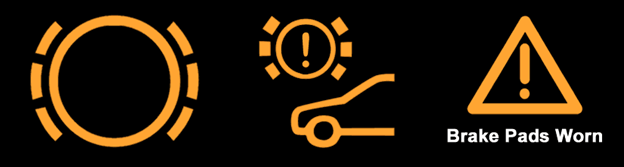
Many modern commuter cars and luxury vehicles feature electronic brake pad wear sensors. When pad thickness drops below safe operating margins (usually around $3/32$ of an inch), the sensor wire wears through, triggering a dedicated brake warning light on your dashboard.
Checking your owner’s manual will help you identify whether your dashboard light signifies low hydraulic fluid or thin brake pads.
6. Visible Thin Friction Material
If your car features open alloy wheels, you can visually inspect your brake pad thickness through the wheel spokes without taking the tire off:
-
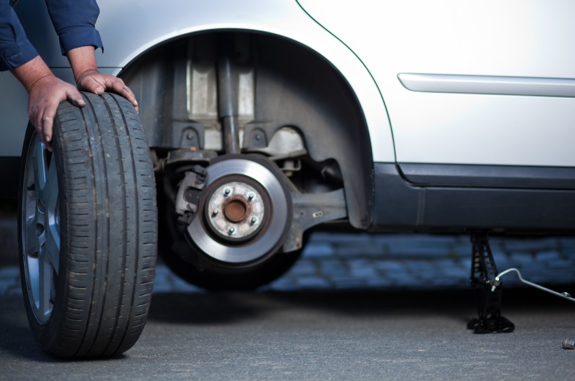
Locate the brake caliper clamped over the shiny round rotor.
-
Look inside the caliper housing to spot the friction pad pressed against the rotor face.
-
Healthy pads should show at least $7\text{ mm}$ (about $1/4$ inch) of pad material.
-
If the pad looks thinner than the metal backing plate behind it (under $4\text{ mm}$), immediate replacement is necessary.
7. Vehicle Pulling to One Side
If your car pulls noticeably to the left or right when you press the brake pedal, your pads are likely wearing unevenly between the driver and passenger sides. One side may be completely worn down due to a sticking caliper pin or uneven hydraulic pressure, creating unbalanced stopping force that can make sudden emergency stops highly unpredictable.
The True Cost of Waiting Too Long
Ignoring these critical warning signs transforms a routine, low-cost maintenance task into a major financial headache:
-
Pad Replacement Only: Replacing thin pads early is fast, straightforward, and affordable.
-
Neglected Pad Damage: Driving on bare metal backing plates destroys the smooth surface of your rotors, forcing you to replace both the pads and rotors together—easily doubling or tripling your total bill.
-
Severe System Failure: Extreme wear can cause caliper pistons to overextend, leak hydraulic brake fluid, or seize completely, resulting in massive repair bills and extreme safety risks.
The Smart Solution: Driveway Mobile Service
When you notice these warning signs, driving a compromised car to a local repair garage or arranging a tow truck is a hassle you don’t need.
Mobile brake repair eliminates the stress. Our ASE-certified technicians bring a fully equipped rolling service bay straight to your driveway or office parking space. We perform an on-site inspection, measure your hardware down to the exact millimeter, text you a clear digital report with photos, and perform a full pad and rotor replacement while you relax inside.
Protect Your Stopping Power Today
Don’t wait for a minor squeak to turn into an expensive metal-on-metal grinding emergency. If your vehicle is exhibiting any of these seven warning signs, address it immediately.
Skip the garage waiting room and eliminate the dangerous drive. Check our site at www. to receive a transparent, upfront estimate for a driveway brake inspection today.
-
Q: Can I drive my car if my brakes are squealing?
-
A: Yes, but only for a short period. Squealing is your pad’s built-in wear indicator warning you that $80\%$ of the friction material is gone. You should schedule a brake inspection immediately before the remaining material wears down to the metal backing plate.
-
-
Q: How many millimeters should new brake pads have?
-
A: Brand new brake pads typically feature between 10mm to 12 text mm of fresh friction material. Replacement is strongly recommended once the material wears down to 3 mm or 4mm
-
-
Q: Why are my inner brake pads wearing faster than the outer ones?
-
A: Inner brake pads often wear faster if your caliper slide pins are dry, unlubricated, or sticking. A professional mobile brake service always cleans and lubricates these slide pins during pad installation to guarantee even wear.
-